


How Glass Bottles Are Made?
Before glass bottle manufacturing starts, all raw materials including silica sand, soda ash, limestone and recycled glass (cullet) must first be combined, heated and melted at temperatures in excess of 1500°C before injecting this molten glass liquid into molds for shaping into bottles. There are three primary methods used in glass bottle forming:
1. Blowing: For this process, molten glass is dropped into a mold before air is blown through it to expand it and fill out its shape.
2. Press and Blow: Pressing glass molten into mold cavities before blowing air through to shape its edges is usually the preferred process, making press-and-blow the most popular choice among glass manufacturers.
3. Injection Blow Molding (IBM): For this technique, an empty hollow tube made out of molten glass called a parison is injected into a mold before being expanded and expanded back out again into bottle shape by blowing.
Once glass bottles have been formed, they must undergo annealing in an annealing lehr to mitigate internal stresses caused by transitioning from high temperatures to room temperatures – such as transition from high pressure heating systems. Slowly cooling these glass bottles helps alleviate internal stresses while strengthening them further. Before being packaged up for delivery to customers, all bottles undergo initial machine inspection for defects followed by secondary manual inspection to ensure only qualified bottles reach customers. Finally, our packaging team will pack these perfect bottles into boxes according to customer specifications, then load them onto pallets for transporting directly to their designated destination.
You can watch the following detailed and intuitive video about glass bottle manufacturing. This video provides a comprehensive overview of the various molding techniques used to shape molten glass in glass bottle molds, as well as the entire process from production to quality inspection to packaging.
How A Glass Bottle Is Made Step by Step
Raw Materials For Making Glass Bottles
At Glass Bottle Manufacturing Company, the primary materials we utilize include silica sand, soda ash, limestone and recycled glass (cullet). Reusing glass saves resources, conserves energy consumption and minimizes waste production – three key sustainability initiatives.
After preparing the raw materials for glass bottle production, the next step is to mix them in the correct proportions. Mixing in the correct proportions is equally crucial. It is essential to ensure that the proportions are consistent across all batches to produce glass bottles of the same quality.

Glass bottles can be customized by adding various chemicals that act as colorants or pigments during their manufacturing. These chemicals can then be blended with glass raw material during melting processes to achieve the desired hue for final bottle production. Some common examples and their effects:
Metal Oxides: Metal oxides are among the most frequently used glass colorants, producing different hues depending on which metals ions they contain in the glass matrix. Iron oxide can give glass a green or brown tint while chromium oxide turns green; manganese oxide results in purple hues while selenium yields red or pink tones.
Sulfides: Sulfides are another popular colorant used to produce darker tones such as brown or black hues, often yielding opaque or translucent effects when added to glassware. Their addition can alter light transmission rates causing it to be opaque or transparent in appearance.
Selenium: Selenium is an increasingly popular colorant used to give glass its signature red or pink hue, depending on how much is added as part of a recipe. Varying selenium amounts can control how intensely its final hue appears in each batch produced.
Tin Sulfide: Tin sulfide is an affordable glass colorant used to give the glass its characteristic yellow-gold hue, often under reducing conditions for optimal functionality. When adding this substance, care must be taken not to disturb or reduce any necessary minerals that form to ensure its effectiveness and to minimize costs for production processes.
Cobalt Oxide: Cobalt oxide can be used as a colorant to produce blue glass; using just the right amount, different hues of blue from deep to light may emerge depending on how much cobalt oxide was added to create various hues of blue glass. Copper Oxide: Copper oxide produces green glass. Its addition may alter saturation or depth of final hue produced.
Rare colored bottles typically require higher minimum order quantities – typically over 300,000 units – due to lower customer demands for these pre-existing hues and factories needing larger order amounts in order to operate boilers dedicated solely for special color batches. When demand drops lower still, customers often choose transparent glass bottles then choose spray painting process – this ordering method being much more flexible for customizing any colors!
Glass Melting During Bottle Manufacturing

Glass Bottle Forming Process
Currently, there are two main processes for producing glass bottles and containers: the blowing method for narrow-necked bottles and the press-and-blow method for larger diameter bottles and jars. In both of these forming processes, molten glass, at its working temperature (1,050-1,200°C), is sheared by blades to form cylindrical droplets of molten glass, known as "gobs". The weight of these gobs is sufficient to produce one bottle. Both processes start with shearing molten glass, where the gobs fall under gravity and are guided through chutes and turning chutes into the initial mold, which is then closed and sealed by a top "plunger".
In the blowing process, the glass is first pressed downwards by compressed air passing through the plunger, forming the glass at the neck mold; then the parison slightly descends, and compressed air passing from bottom to top through the gap at the core expands and extrudes the glass to fill the initial mold. Through this glass blowing, a hollow preform shape is formed, which is subsequently blown again in the second stage to achieve the final shape by compressed air. The gob is pressed in the initial mold to shape the neck, and then transferred to the forming mold for blowing shaping. The blowing method is generally used to produce bottles with small openings, such as wine bottles, liquor bottles, and some diffsuer bottles.

Gob dropped into black mold

Neck formed

Blank blown

Blank shape
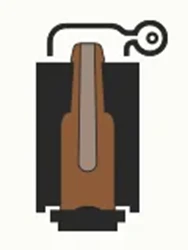
Blank transferred to blow mold

Final shape blown

Finished bottle
Press and Blow Process
The Press and Blow method involves the use of both a plunger and air to shape bottles. When the molten gob falls into the individual section, a plunger pushes it to fit the mold. This action defines it into a parison which is then transferred to a blow mold. There, it is reheated and blown with air until it is properly shaped. This method is preferred for wide-mouth glass containers such as glass vases, glass candle jars or milk bottles.

Gob dropped into black mold

Plunger presses blank shape

Blank pressed

Blank shape

Blank transferred to blow mold

Final shape blown

Finished bottle
Annealing and Cooling in Glass Bottles Manufacturing
We control the annealing process to:
- Ensure the consistency of material
- Minimize stresses
- Prevent spontaneous breakage

Surface Treatment
Surface treatments are performed on the exterior of glass bottles when they are complete. They can be used for decoration, labeling and even protection against abrasion. We have specialized equipment and know-how in performing various treatments including:
Engraving
Screen Printing
Spray Painting
Crackling
Electroplating
Baking
Frosting
Matting